

Remington Typewriter Segment Shifter Stuck? 3 Fixes
How to Fix a Stuck Remington Typewriter Segment Shifter: 3 Methods That Work
You’re mid-sentence. You hit Shift. Nothing happens — or worse, the basket drops and just stays there, blocking every key. Your Remington suddenly can’t type in uppercase, and now you’re staring at a machine you love wondering if it’s worth anything more than a shelf ornament.
Take a breath. A stuck Remington typewriter segment shifter is one of the most fixable problems in vintage typewriter repair, and roughly 70% of cases resolve in under an hour with nothing more than mineral spirits and a few drops of sewing machine oil. The other 30% need a bit more digging, but they’re still very much DIY territory if you’re patient.
This guide walks you through all three fixes — from the quick clean-and-lube job you can do this weekend, to the mechanical adjustment that gets the shift basket moving smoothly again, to the component replacement that handles genuinely broken parts. We’ll cover which Remington models are most prone to this problem, what’s actually causing the sticking, and exactly when to put the tools down and call a professional.
What Is the Segment Shifter — and Why Does It Get Stuck?
Before diving into repairs, a quick thirty seconds on what’s actually happening inside your machine. The segment shifter (you’ll also hear it called the “shift basket” or “character basket”) is the metal cradle that holds all 44 to 50 typebars on your Remington. When you press the shift key, a mechanical linkage — a series of rods, pivot pins, and a return spring — pulls the entire basket down about 3 to 5 millimeters. That small drop is enough to switch from lowercase to uppercase. When you release shift, the return spring pushes the basket back to its neutral position.
That’s a lot of coordinated movement happening in the fraction of a second between pressing the key and the typebar hitting the platen. And Remington designed these mechanisms with more pivot points than competitors like Royal or Smith-Corona, which is part of what makes them feel so refined — and part of why they develop more friction failure points over 70+ years of storage.
The most common Remington models you’ll be working on:
- Remington Quiet-Riter (1930s–1940s) — portable with a floating shift design; linkage rods are thin and prone to bending
- Remington Noiseless / Noiseless Portable (1930s–1950s) — the complex one; multiple felt dampening pads add extra failure points
- Remington Streamliner (1940s–1950s) — sleek aluminium body, shift mechanism prone to lubricant gumming
- Remington Rand (1930s–1960s) — commercial portables; generally sturdy, but seized pivot pins are common
- Remington Holiday (1950s) — simplified mechanism, lower-cost metal; linkage bends more easily
The root cause is almost always one of five things: dried lubricant turned to sticky paste, a bent linkage rod, a weakened or broken return spring, corroded pivot pins, or — in the case of Noiseless models specifically — deteriorated felt dampening pads. Machines that sat in a closet for a decade, were stored in humidity, or went through an over-enthusiastic amateur repair with WD-40 are the prime candidates.
Quick Diagnostic: What Symptom Do You Have?
| Symptom | Probable Cause | Start With |
|---|---|---|
| Shift basket moves sluggishly but does return | Dried/gummed lubricant | Fix #1 (Cleaning) |
| Basket drops fine but won’t spring back | Weak return spring or linkage resistance | Fix #2 (Adjustment) |
| Shift key won’t move at all, or basket drops and stays down | Broken spring, bent rod, or seized pivot | Fix #2, escalate to Fix #3 |
What You’ll Need: Tools & Materials
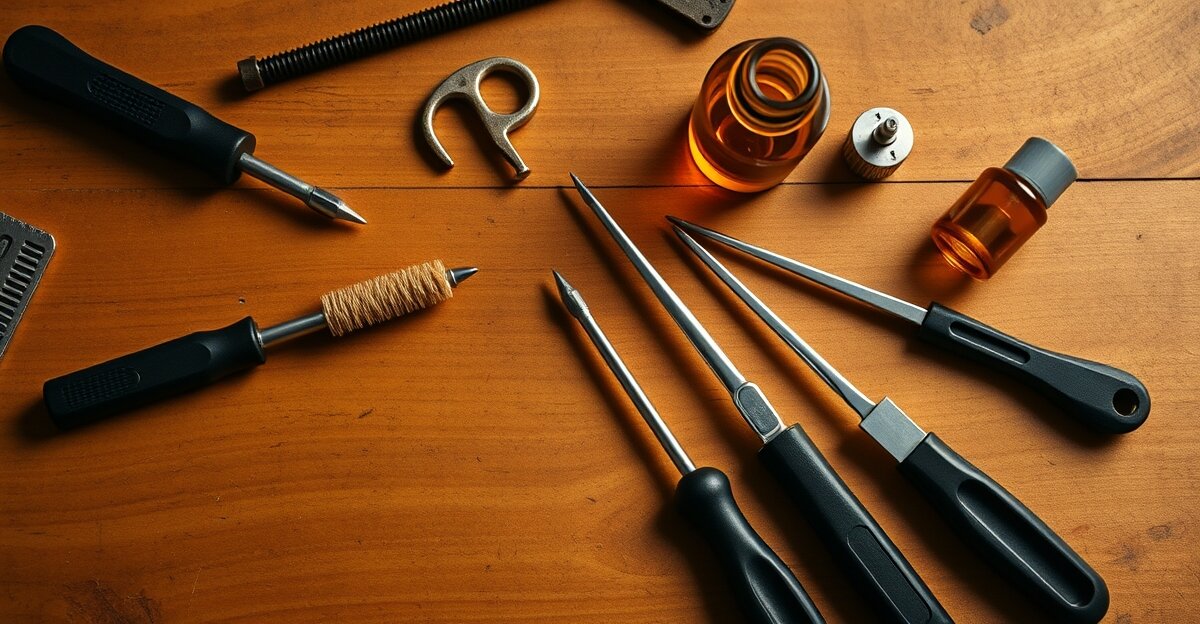
No need to buy a specialized typewriter repair kit. Here’s what the job actually requires, with rough costs:
| Item | Approximate Cost |
|---|---|
| Mineral spirits (1 quart) | $5–8 |
| Sewing machine oil or Tri-Flow PTFE lubricant | $4–10 |
| Small spray bottle or 60cc syringe | $2–4 |
| Soft brass brush or old toothbrush | $2–5 |
| #0 and #1 Phillips screwdrivers | Already own / $5 |
| Needle-nose pliers | Already own / $8 |
| 3/16″ or 1/4″ wrench (or adjustable wrench) | Already own / $10 |
| Cotton rags / paper towels | Already own |
| Rubber gloves + eye protection | $3–6 |
| Rubber mallet (Fix #2 only) | $8–12 |
| Needle-nose tweezers or dental pick (Fix #2) | $3–6 |
| Replacement spring or linkage parts (Fix #3 only) | $8–50 (if needed) |
Total investment for Fix #1: $10–20. For a complete toolkit covering all three fixes: $40–60, and you’ll reuse everything on every vintage machine you touch after this.
One important distinction: mineral spirits and mineral oil are completely different things. You want mineral spirits — the paint thinner/solvent, not the laxative. It dissolves old grease without leaving residue. Mineral oil is a lubricant, not a solvent, and won’t help here.
Fix #1: Cleaning & Lubrication (Start Here — 70% Success Rate)
Best for: Shift basket that moves but sticks, especially on machines that haven’t been used in years.
Time required: 45–60 minutes
Difficulty: Beginner
Cost: $5–15
This is the fix that works for most stuck Remington typewriters. Original factory lubricant — usually a heavy oil blend — oxidizes and hardens over decades. Dust, tobacco residue from the office era, and ambient grime mix with that oil to create a sticky paste that makes every moving part feel like it’s glued in place. On a Remington Noiseless from the 1940s, you can sometimes actually see the brown gunk packed around the pivot points if you shine a flashlight underneath.
Mineral spirits dissolves all of that. Then a thin fresh oil gets the mechanism gliding again.
Step-by-Step Cleaning Process
Step 1 — Set up your workspace. Lay down newspaper or an old towel. Mineral spirits won’t destroy a tabletop, but it will leave an oily patch. Wear rubber gloves; the solvent is skin-drying with extended contact.
Step 2 — Remove the ribbon and paper. You don’t want mineral spirits contaminating your ribbon or the platen rubber. Pull the ribbon off the spools and set it aside.
Step 3 — Locate the shift mechanism. Tilt the machine back or look underneath the carriage area. You’re looking for the shift basket (the large metal frame holding the typebars) and the linkage connecting it to the shift keys. On most Remington portables, the main pivot points are visible from the front, just below the typebars.
Step 4 — Apply mineral spirits to the pivot points. Using a small spray bottle or syringe, apply mineral spirits directly to:
- Each pivot point where a linkage rod connects
- The main return spring (usually on the right side of the basket)
- The underside of the shift basket itself where it contacts its bearing surfaces
Don’t be shy with the solvent. You want it flowing into the joints.
Step 5 — Work the shift key repeatedly. Press the shift key up and down 20 to 30 times while the mineral spirits are wet. This distributes the solvent through the mechanism and starts breaking up the gummed lubricant. You may feel it loosen almost immediately, or it may take several cycles.
Step 6 — Let it soak for 10–15 minutes. Go make a coffee. The solvent needs time to penetrate the old lubricant.
Step 7 — Repeat the spray-and-work cycle 2–3 more times. On a really gummed-up machine, the first soak loosens the surface layer; subsequent applications get deeper into the joints. You’ll know it’s working when the fluid running off the mechanism starts looking cleaner.
Step 8 — Wipe away the excess mineral spirits. Use clean cotton rags or paper towels to blot up the pooling solvent underneath the machine and on accessible surfaces.
Step 9 — Wait 5 minutes for full evaporation. This step matters. If you oil too soon, you’re trapping mineral spirits in the joint with the new lubricant. Let the solvent fully evaporate — you’ll notice the solvent smell diminish.
Step 10 — Apply fresh lubricant. Two to three drops of sewing machine oil at each pivot point is the right amount. Less than you think. You’re lubricating precision metal-on-metal contact, not greasing a lawn mower axle. If you have Tri-Flow PTFE lubricant, this is an even better choice — the PTFE additive reduces metal friction and it’s the go-to in the vintage typewriter enthusiast community.
Work the shift lever 10 more times to distribute the oil. Wipe away any excess that drips — pooling oil attracts dust and recreates the problem.
Does it feel smooth and does the basket spring back without hesitation? You’re done. If there’s still sticking, repeat the process once more before moving to Fix #2.
The lubricant guide on this site goes deeper on oil choices for vintage equipment — including a full comparison of mineral spirits vs. sewing machine oil vs. Tri-Flow that’s worth reading before you buy anything: The Complete Guide to Vintage Equipment Restoration.
Fix #2: Mechanical Adjustment & Linkage Inspection (Moderate Difficulty)
Best for: Basket that moves partially or slowly despite cleaning; return spring feels weak; visible misalignment.
Time required: 1.5–2.5 hours
Difficulty: Intermediate
Cost: $0–10 (tools and lubricant only, no parts required)
If cleaning didn’t solve it, the problem is mechanical rather than chemical. The most common culprit at this stage is a slightly bent linkage rod — something that happens easily during shipping, improper storage, or when someone previously tried to force a jammed shift basket back up by hand. A rod that’s even 2–3 degrees out of true creates binding at the pivot points that no amount of lubrication will fix.
The other frequent offender is a return spring that’s lost tension. Springs fatigue over decades of use. One that should have 1–2cm of preload might now be nearly slack, giving the basket too little force to return to neutral.
Part A: Remove the Shift Basket for Inspection
Before you touch a single bolt: Take a photograph of the linkage configuration from multiple angles. On a Remington Rand or Quiet-Riter, the reassembly orientation isn’t always obvious, and you’ll thank yourself later. Seriously — don’t skip this.
- Locate the two main connection points where the linkage rods attach to the basket. On most Remington portables, these are connector bolts, usually 3/16″ or 1/4″.
- Using your wrench, remove the connector bolts. Keep them in a small bowl — losing a 3/16″ bolt inside a typewriter is a miserable experience.
- Gently pull the basket forward and downward. It should come free without significant resistance. If it doesn’t, check for any additional fasteners you may have missed.
- Set the basket on a clean surface. Inspect for hairline cracks, especially around bolt holes — these sometimes explain why nothing else has worked.
- Clean the basket itself with mineral spirits and a soft brush while it’s out.
Part B: Inspect the Linkage for Bends
With the basket removed, you now have clear access to the entire shift linkage. This is where the Royal Quiet De Luxe and the Remington diverge — Remington linkage involves more discrete rods that each need individual inspection.
- Hold a straight-edge ruler along each linkage rod. Even a slight arc is visible.
- Check the pivot pins for corrosion. Surface rust (light reddish-brown discoloration) is fine and will clean up. Deep pitting means the pin is eating into the hole, which is a Fix #3 job.
- Check the return spring tension. Compressed slightly, the spring should feel firm; with the basket removed, it should maintain about 1–2cm of natural preload.
Part C: Straighten Bent Linkage Rods
If a rod is slightly bent:
- Support the rod from underneath with a small wooden block.
- Place a second block on top as a spacer, positioned at the high point of the bend.
- Tap gently with a rubber mallet until the rod straightens. Gentle here — you’re bending thin steel rod, not hammering a tent stake.
- Re-check with the straight-edge. Repeat if needed.
If connector bolts are loose (creating too much play in the linkage):
- Tighten by a quarter-turn at a time
- Test the shift action after each quarter-turn
- Stop when the motion is smooth; over-tightening cracks the connector sleeve
Part D: Adjust Return Spring Tension
The return spring on most Remington portables anchors to the basket and to a fixed point on the frame — usually on the right side when looking at the machine from the front.
If the spring feels slack (no preload when basket is in neutral position):
1. Locate the spring’s anchor bolt on the frame side
2. Loosen the anchor bolt slightly
3. Stretch the spring to add 1–2cm of additional preload
4. Retighten the anchor bolt firmly
If the spring is broken or detached and won’t take adjustment: skip directly to Fix #3.
Part E: Reassemble and Test
- Reattach the basket using your photograph as a guide — orientation matters
- Reinstall connector bolts; snug but not over-tight
- Apply 3–5 drops of sewing machine oil to each pivot point
- Test the shift key through 20 cycles. You want clean drop and clean return with no hesitation
- If there’s still sticking after proper assembly, apply one more round of mineral spirits followed by fresh oil
Fix #3: Component Replacement (Advanced)
Best for: Broken return spring, cracked linkage rods, severely corroded pivot pins, or failed Fixes #1 and #2.
Time required: 2–4 hours
Difficulty: Advanced
Cost: $10–50 for parts; $50–100 if you outsource pivot pin work
This is the fix you turn to when something is genuinely damaged rather than just dirty or misaligned. The good news is that Remington portables were produced in enormous quantities through the 1950s, which means replacement parts are findable if you know where to look.
Sourcing Parts
Your best three channels:
eBay — Search “Remington [your model] parts” or “Remington typewriter shift spring.” Inventory is wildly variable; sometimes you’ll find exactly the component you need for $8, other times you’ll search for a week. For linkage rods, look for the same model in “for parts/not working” listings and harvest what you need (often cheaper than a single component shipped separately).
Etsy — A handful of specialty sellers stock curated Remington parts with better quality control than random eBay listings. Expect to pay a slight premium, but these sellers usually know exactly what they’re selling and can answer model-specific questions.
Facebook Marketplace / local estate sales — A junker Remington Rand for $20–30 is the best parts source you’ll find. You get the spring, every linkage rod, and every pivot pin at once, and you can test-fit everything before committing.
Local typewriter repair shops — Worth a phone call. Some shops keep a bin of salvage parts; prices vary widely.
Return Spring Replacement
- With the basket removed (see Fix #2, Part A), note where the spring attaches at both ends — basket side and frame side
- Remove the two bolts holding the spring; keep track of which end is which
- Remove the broken spring
- Test-fit the new spring before final installation to confirm the length and attachment holes match
- Install new spring; tighten bolts; test for 1–2cm preload with basket in neutral position
- Reassemble basket and test through 20 shift cycles
Linkage Rod Replacement
- Remove connector bolts at both ends of the cracked or broken rod
- Slide the rod out of its connector sleeves; measure the length and diameter with calipers (usually 2–3mm diameter on Remington portables)
- Source a matching rod from a parts machine or fabricate from steel rod stock ($5–10 at a hardware store)
- Install the new rod, align it straight with the other linkage components
- Tighten connectors and lubricate
Felt Pad Replacement (Noiseless Models Only)
The Remington Noiseless and Noiseless Portable use felt dampening pads under the typebar basket — the whole reason the machine is so quiet. These felt pads deteriorate over 70-plus years: they harden, compress, or crumble, and when they do, the basket doesn’t seat properly in neutral position.
This is a repair you’ll only need on Noiseless models, but if you own one, it’s worth doing:
- Locate the worn felt pads under the basket (they look like hard, compressed discs of dried felt)
- Peel the old felt off carefully — it usually comes off in pieces at this point
- Cut new adhesive-backed felt to size using the old pad as a template (adhesive felt sheets run $5–10 for a full sheet, available at any craft store)
- Apply contact cement or spray adhesive to the typewriter surface
- Press new felt firmly in place; let cure for 24 hours before testing
- After curing, the basket should seat more quietly and sit at the correct neutral height
When to Stop and Call a Professional
Pivot pin replacement is the one job in this guide I’d genuinely recommend leaving to a professional unless you’re already comfortable with press-fit pin work. Removing corroded pivot pins without damaging the surrounding casting requires either a pin press or very precise drilling — and a slipped drill bit can destroy a bracket that’s irreplaceable. Professional shops charge $50–100 for this repair specifically, and it’s worth it.
Other red flags that mean stop and get help:
- You strip a bolt during removal
- A linkage component breaks during straightening
- The machine has pre-existing structural damage (cracked casting, warped base)
Common Mistakes That Make Things Worse
The WD-40 Problem (Read This Before You Open a Can)
WD-40 is a water displacer and light solvent — not a lubricant, despite the fact that half the internet recommends it for typewriters. On a fresh application it makes everything move smoothly, which is why people swear by it. The problem: it evaporates quickly, leaving behind a slightly sticky residue that actually accelerates dirt accumulation. A machine treated with WD-40 will feel great for two weeks and then gum up worse than before. Use mineral spirits for cleaning, sewing machine oil or Tri-Flow for lubrication. That’s the right pairing.
Over-Tightening Connector Bolts
These are soft metal castings from the 1930s–1950s. They don’t need to be cranked down. Snug is sufficient. I’ve seen machines arrive for repair with stripped bolt holes that required a thread-repair kit (Helicoil inserts) because a previous owner over-tightened during reassembly — adding a 90-minute detour to what should have been a 20-minute fix.
Skipping the Photo Before Disassembly
Remington linkage configurations vary between models and production years. The Streamliner’s shift linkage looks different from the Quiet-Riter’s, and both look different from the Noiseless Portable. If you don’t photograph before you remove anything, you may spend 45 minutes trying to figure out where one particular rod goes during reassembly. Take the photo. It takes 10 seconds.
Forcing a Stuck Basket by Hand
The thing most people do when their shift basket won’t return: push up on it with their fingers. If the problem is a bent rod or seized pivot, forcing the basket up can deepen the bend or snap the rod entirely, turning a Fix #1 job into a Fix #3 job. Work with the mechanism, not against it — apply solvent, let it soak, and work the shift key gently rather than muscling the basket directly.
Using Heavy Grease on the Shift Linkage
Some people reach for bicycle chain grease or similar heavy lubricants. Don’t. Heavy grease accumulates dust, and on a mechanism that needs to move in tight tolerances, grit-contaminated grease creates grinding friction within weeks. Thin oil only.
Cost Comparison: DIY vs. Professional Repair
If you’re on the fence about whether to attempt this yourself, here’s the honest math:
| Repair Route | Typical Cost | Time | Risk |
|---|---|---|---|
| Fix #1 (cleaning) — DIY | $5–15 | 45–60 min | Very low |
| Fix #2 (adjustment) — DIY | $0–10 | 1.5–2.5 hrs | Low–moderate |
| Fix #3 (parts replacement) — DIY | $10–50 | 2–4 hrs | Moderate |
| Professional typewriter repair shop | $80–150+ | 1–3 weeks turnaround | None |
The professional repair cost isn’t unreasonable — typewriter technicians are rare, and the labor involved in a proper linkage rebuild takes real skill. But for a machine you bought for $25 at a flea market, paying $120 for a repair doesn’t make economic sense. Fix #1 costs less than a lunch.
The one scenario where professional repair genuinely makes sense: the machine has sentimental or collector value above $300, and you’re dealing with seized pivot pins or structural damage. Don’t risk a valuable machine to save $80.
This site has a broader look at repair economics if you’re weighing whether to invest in a vintage machine at all: Royal Quiet De Luxe Typewriter Repair: Common Problems Fixed covers similar decision points for Royal machines that apply across the vintage typewriter category.
Frequently Asked Questions
Can I use PB Blaster or penetrating oil instead of mineral spirits?
PB Blaster and similar penetrating oils work — they'll dissolve gummed lubricant just as mineral spirits will — but they leave an oily residue that can interfere with re-lubrication and may affect rubber components (like the platen) if it gets where it shouldn't. Mineral spirits evaporates cleanly, leaves no residue, and is the standard choice among vintage typewriter restorers. If you only have PB Blaster on hand and need to start immediately, it won't destroy your machine, but clean up thoroughly before applying fresh oil.
How do I know if my return spring is broken versus just weak?
A broken spring is usually visible — look for a gap in the coil or a detached end. A weak spring won't be broken visibly; the basket will just feel sluggish returning to neutral and may need a slight push with your finger to fully seat. If you can see both ends of the spring are intact and attached, try adjusting the anchor point tension (Fix #2, Part D) before ordering a replacement.
My Remington Noiseless has a shift problem. Is it different from other models?
Yes, in a few important ways. The Noiseless mechanism adds felt dampening pads that standard Remington portables don't have, and those pads are a common source of problems on machines 70+ years old. The Noiseless also has more complex linkage with tighter tolerances — it was designed to be extraordinarily quiet, which means more moving parts. Start with Fix #1 just as you would on any other model, but if the cleaning doesn't resolve it, check the felt pads before assuming you have a linkage problem. The felt pad replacement in Fix #3 is specific to Noiseless models and often the actual culprit.
Is it worth repairing a typewriter with a stuck segment shifter, or should I just buy another one?
Depends on the machine. If you paid $15 for a beater Remington Holiday at an estate sale and the shift is your only problem, Fix #1 is absolutely worth attempting — you're out $10 in materials and an hour of your Saturday if it doesn't work. If you have a Noiseless Portable in good cosmetic condition, those machines are genuinely beautiful to type on and worth a proper repair investment. The math tips against repair when you're looking at a machine with multiple problems (sticky keys, broken platen, seized segment shifter) and the combined repair cost approaches what a clean machine would cost to buy.
How many times can I clean and re-lubricate a typewriter before it starts having problems?
Indefinitely, assuming you're using the right products. Sewing machine oil and Tri-Flow PTFE are appropriate for lifetime use on vintage mechanisms; they don't degrade the metal and the small amounts involved don't accumulate enough to cause problems if you wipe away excess. The machines themselves don't wear out from proper lubrication — it's improper lubrication (WD-40, heavy grease, oil that's left to gum up) that creates the problems in the first place. A well-maintained Remington in regular use should need only a light oiling at the pivot points every year or two.
Where's the best place to find a service manual for my specific Remington model?
The Typewriter Database (typewriterdatabase.com) is the go-to reference for model identification and production dates. For actual service manuals, the Smithsonian Institution Archives holds several Remington service documents, and some have been digitized and shared through the typewriter enthusiast community at r/typewriters. Phoenix Typewriter on YouTube also has model-specific teardown videos that serve the same purpose as a written service manual for most common repairs.
Where to Go From Here
Most stuck Remington typewriters have been sitting in a closet for a decade, slowly building up a paste of oxidized factory oil and decades of dust. Fix #1 — mineral spirits flush followed by fresh sewing machine oil — resolves that in under an hour for the majority of machines you’ll encounter.
If Fix #1 doesn’t do it, you now know exactly what to look at: bent linkage, weak spring, or (on Noiseless models) deteriorated felt pads. None of those are beyond a patient hobbyist with the right tools.
Start with Fix #1 this weekend. Worst case, you’ve spent $10 and given your Remington a proper cleaning it was overdue for regardless. Best case, you’ve saved yourself a $100+ repair bill and come away understanding your machine in a way you didn’t before.
Vintage typewriters were built to last a century. Yours just needs a little attention.
Looking to keep your vintage typewriter in proper condition for years to come? The principles in our oiling guide for vintage sewing machines translate directly to typewriter maintenance — thin oil, metal-on-metal contact points, and patience with old mechanisms are universal.